Learn to run with your head
From your first walk-run outing to a marathon plan. Written from systematic reviews and official position stands, with the source next to every number.
- chapters
- 16
- of total reading
- 127 min
- sources cited
- 41
Four tracks, in order
Read it top to bottom, or jump straight into the chapter you need today.
Track 1
Fundamentals
How to start without getting injured, what really drives your performance, how to measure effort honestly, and where your paces come from.
1. Starting to run
The walk-run method, how many days, how long, and why the classic beginner mistake is not running slowly but running too soon.
2. Runner physiology
VO₂max, threshold and running economy: the three engines of distance running, what training improves each, and why the most trainable one is not the most measured.
3. Zones and intensity
The three-zone model, where 80/20 comes from, how to estimate your threshold with a field test, and why most recreational runners train in a grey zone that achieves nothing.
4. vVO₂max and paces
What maximal aerobic speed is, how to measure it with a six-minute field test, how all your zones and target paces come out of it, and how often to measure it again.
Track 2
Disciplines and sessions
The catalogue of running sessions and the disciplines that exist: road, track, cross country, trail, ultra and treadmill.
5. Session types
The full catalogue of running sessions, what adaptation each one targets, how it is prescribed, and how many fit in a week without piling up fatigue.
6. Structured sessions
The anatomy of a session: steps, target, intensity, repetitions and recovery. The rules that decide how long an interval lasts and how much you rest, and how to read the notation you will find in any plan.
7. Running disciplines
What changes between road, track, cross country, mountain, ultra-distance and treadmill running: demands, risks, kit and how you train for each.
8. Trail and mountain
How effort is measured when pace stops working, why the descent is what hurts, how to train it, and which kit actually changes something.
9. Technique and cadence
Cadence as the one technique variable with clear support, the foot-strike debate, and how much carbon-plated shoes really contribute.
Track 3
Planning your goal
Turning individual sessions into a sustainable week and into a 5K, 10K, half or marathon block.
10. Plan your week
How much volume, how to split it, how much to add each week, and what the evidence actually says about the famous 10% rule.
11. Distance goals
What changes in the plan depending on the target distance: block length, key sessions, pacing strategy, and how to taper.
12. Strength for runners
Heavy loads and plyometrics improve economy and performance without touching VO₂max. Which exercises, how many sets, and how to fit it in without arriving wrecked to your intervals.
Track 4
Sustaining it
Injuries, in-race fuelling and hydration, how to choose shoes, and the shared vocabulary for reading any plan.
13. Preventing injuries
How many injuries there really are, why load explains more than technique, what the studies say about prevention programs, and how to manage a niggle without stopping running.
14. Eating and drinking on the run
When you need to eat while running, how many grams per hour depending on duration, why drinking to thirst is safer than drinking to a plan, and what to do before and after.
15. Choosing running shoes
Why foot type should not drive your purchase, what cushioning, drop and weight mean according to the trials, which shoe suits each use and terrain, and how much carbon plates really give you.
16. Glossary
The terms that show up in any running plan, forum or study, explained in one line and without unnecessary jargon.
What you can expect from this guide
Training is full of confident claims with no source behind them. Here the rule is the opposite.
Sources, not opinions
Every numerical claim comes with its meta-analysis, review or official position stand, linked and dated.
The confidence level is stated
High, moderate or limited. If the evidence is weak we say so; if it is common practice with no backing, we say that too.
No promises, and no substitutes
This is education, not medical prescription. With a diagnosed condition or persistent pain, your healthcare professional decides.
Full bibliography
41 sources: meta-analyses, systematic reviews, position stands and official guidelines.
Reading is fine. Getting out the door is what changes the outcome
My PR handles running sessions with their steps, target paces and recoveries, inside the same plan as your strength work.
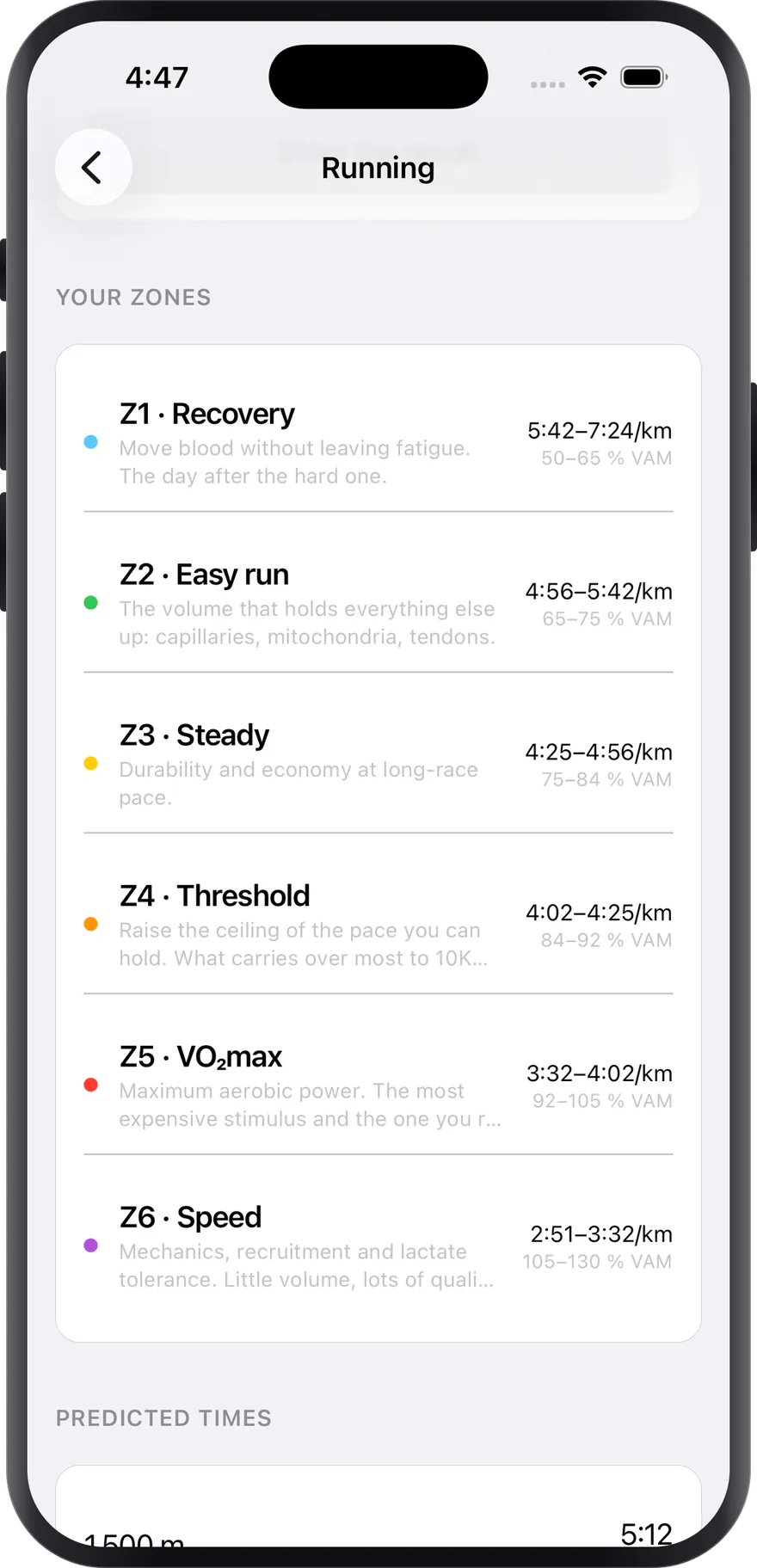
Six zones, each with its own pace
From recovery to speed, with the exact pace of each zone and what it is for. Running by feel ends the moment you carry this table in your pocket.