Learn to train with intent
Fourteen chapters that go from “what do I do on day one” to “how many calories do I need”. Written from meta-analyses, systematic reviews and the WHO and ACSM position stands, with the source next to every number.
- chapters
- 14
- of total reading
- 127 min
- sources cited
- 42
Four tracks, in order
Read it top to bottom, or jump straight into the chapter you need today.
Track 1
Fundamentals
What to do on day one, why it works, and what volume, load and effort actually mean.
1. Starting from scratch
The minimum you need to train well from day one: how many days, how many sets, how much weight, and what to expect month by month.
2. How muscle grows
Mechanical tension, neural and structural adaptations, and the five principles that explain why a plan works or does not.
3. Variables
Volume, load, proximity to failure, frequency, rest, range of motion and tempo: what the evidence says about each, and what range to use.
Track 2
Exercises and execution
The biomechanics that change decisions, how to choose exercises, and which technique myths you can ignore.
4. Biomechanics
Moment arms, the length–tension relationship and resistance profiles. The part of the physics that actually changes how you pick and perform exercises.
5. Exercise selection
Movement patterns, the stimulus-to-fatigue criterion, how many exercises per muscle, and how to swap one without breaking the plan.
6. Technique and safety
General rules of execution, how to warm up, what to do about pain, and what the evidence says about the classic myths.
Track 3
Programming
Turning principles into a calendar: weekly structure, progression, deloads and metrics.
7. Plan your week
Full body, upper/lower and push-pull-legs compared, with complete templates for 2, 3, 4 and 5 days.
8. Progression
The six routes to progressive overload, how to build a mesocycle, when to deload, and what to do when you stall.
9. Measuring progress
Estimated 1RM, effective volume, RIR and body measurements. Which signal is reliable, how often to look at it, and when to act.
Track 4
Energy and calories
Where your expenditure comes from, how fast to lose or gain, and why the number expires the moment your weight moves.
10. Your expenditure
Where the number comes from: resting metabolic rate, activity factor, and which equation to use. Including what is known about their accuracy, which is less than any calculator implies.
11. Planning kcal
How fast to lose or gain, why the 7,700 kcal per kilo rule promises dates it cannot keep, and how to split protein, fat and carbohydrate.
Track 5
Sustaining it
Recovery, long-term health, and the shared vocabulary for reading any plan or study.
12. Recovery
What decides whether the stimulus becomes adaptation: sleeping, eating enough protein, and managing accumulated fatigue.
13. Strength and health
What the WHO and the ACSM recommend, why strength is critical past 40, and how to combine cardio and weights without losing anything.
14. Glossary
The terms that show up in any plan, explained in one line, with the number that goes with them.
What you can expect from this guide
Training is full of confident claims with no source behind them. Here the rule is the opposite.
Sources, not opinions
Every numerical claim comes with its meta-analysis, review or official position stand, linked and dated.
The confidence level is stated
High, moderate or limited. If the evidence is weak we say so; if it is common practice with no backing, we say that too.
No promises, and no substitutes
This is education, not medical prescription. With a diagnosed condition or persistent pain, your healthcare professional decides.
Full bibliography
42 sources: meta-analyses, systematic reviews, position stands and official guidelines.
Reading is fine. Logging is what changes the outcome
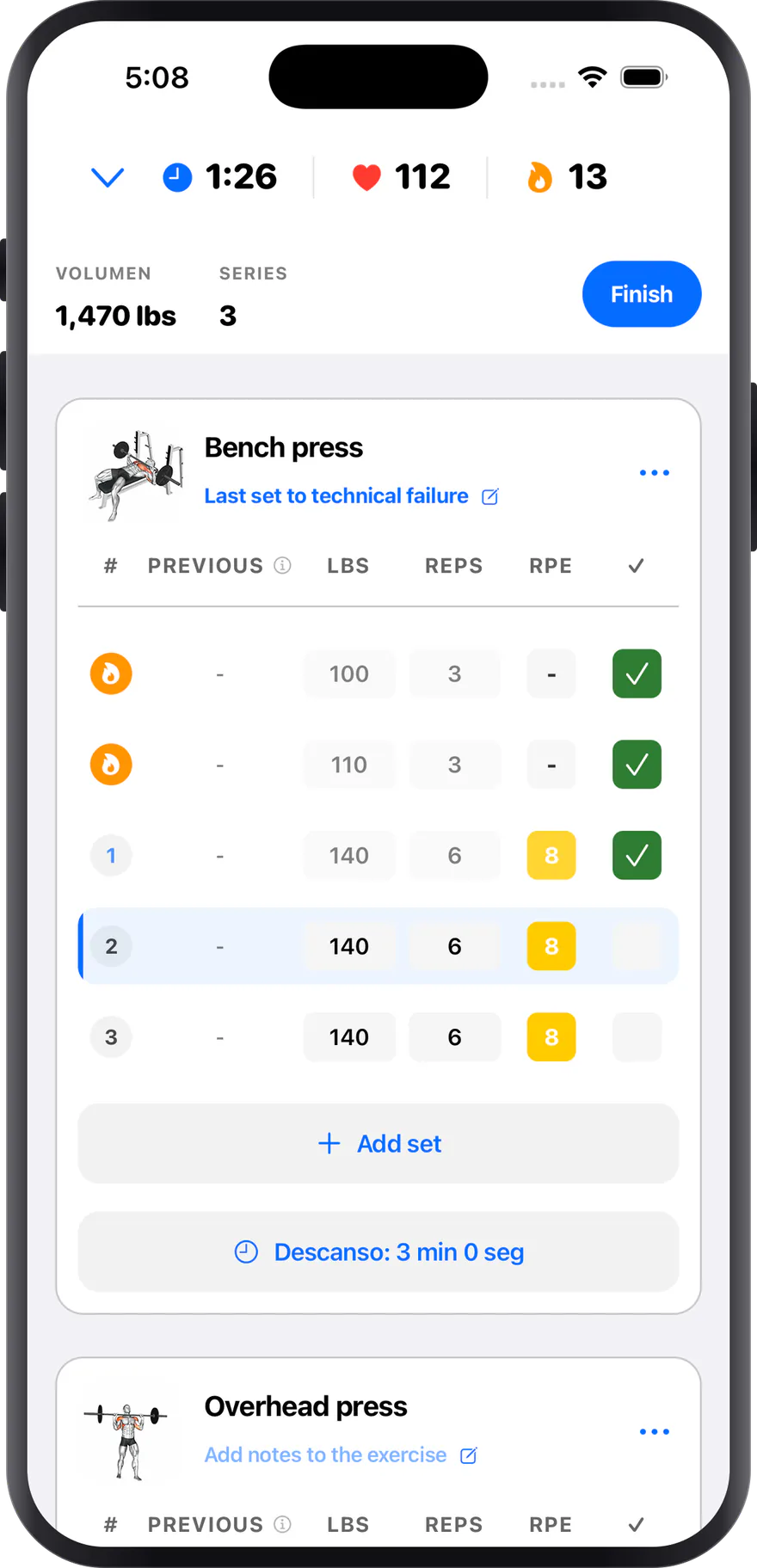
My PR applies what is in this guide: volume per muscle, RIR per set, automatic progression and estimated 1RM per exercise.
Logging in one tap
The set table is built to be used standing up, between sets: weight, reps, RPE and rest without leaving the exercise screen, with your previous session right next to them.