Supplements, without the hype
Twelve chapters that go from "does this do anything?" to "which one do I buy and for how much". Written from the ISSN position stands, the IOC consensus and the AIS framework, with the source next to every dose.
- chapters
- 16
- of total reading
- 169 min
- sources cited
- 86
Four tracks, in order
Read it top to bottom, or jump straight into the chapter you need today.
Track 1
Fundamentals
How much a supplement can move at most, which ones have cleared the evidence bar, and what a label does and does not guarantee.
1. What to expect
The real order of magnitude: how much a supplement adds next to training, eating and sleeping. And why that order decides where the money should go.
2. What works
The full list of supplements with solid evidence fits in one table. Which they are, what each is for, what dose, and what it costs per month.
3. Quality and labels
What share of supplements does not contain what it says, which certifications actually mean something, and how to read a label without swallowing the marketing.
Track 2
Protein and amino acids
The best-selling family: what really separates one from another, how much per serving, and which loose amino acids are worth the money.
4. Protein types
Concentrate, isolate, hydrolysate, casein, plant blends and collagen: how they actually differ, which to pick, and when the powder adds nothing over food.
5. Amino acids
EAAs, BCAAs, leucine, HMB, glutamine, citrulline. Which has an effect of its own, which is an expensive version of something you already eat, and why BCAAs still sell.
Track 3
Performance
The ones with a measured effect: creatine, caffeine, and everything you eat, drink and take around a run.
6. Creatine
What it does, what dose, why monohydrate beats every expensive form, and what is true about hair, kidneys and water retention.
7. Caffeine
The most versatile ergogenic aid there is: dose per kilo, when to take it, why it does nothing for some people, and what is really inside a pre-workout.
8. For running
Gels, drinks, salts, nitrate, beta-alanine and bicarbonate: what to use by distance, how many grams an hour, and how to train your gut to tolerate them.
Track 4
Health and micronutrients
The deficiencies that are worth correcting. Start with the general chapter —which ones to check and why— and carry on into the detail of every vitamin and every mineral.
Track 5
Vitamins and minerals, one by one
The detail: what each vitamin does, how much you need, the dose at which it stops being harmless, and the blood test that confirms it.
10. Fat-soluble (A, D, E, K)
The four that accumulate: what each one does, how much you actually need, the dose at which they stop being harmless, and why only one of them is supplemented routinely.
11. Water-soluble (B and C)
The ones you urinate out, which is why they are sold at absurd doses: what each B vitamin does, which one is non-negotiable on a vegan diet, and which one is genuinely toxic.
12. Minerals
Iron with its ferritin thresholds, magnesium and what it actually does about cramps, zinc, calcium, and the three almost nobody checks: iodine, selenium and potassium.
13. Blood tests
The page that turns the previous three chapters into a decision: which markers answer something, when to test, how to read a value that is "within range", and what to do with each result.
Track 6
What to buy
The products worth dropping and the final decision: what to get, in what order and for how much.
14. What does not work
Fat burners, testosterone boosters, glutamine, BCAAs, ketones and company: what the evidence says about each, and why they still get the best shelf space.
15. How to buy
The final decision: what to get for your goal and your budget, how to compare prices honestly, and in what order to add products if you want to build up.
16. Glossary
The vocabulary that shows up on labels and in studies, explained once: from DIAAS to hepcidin, from proprietary blend to group A.
What you can expect from this guide
Training is full of confident claims with no source behind them. Here the rule is the opposite.
Sources, not opinions
Every numerical claim comes with its meta-analysis, review or official position stand, linked and dated.
The confidence level is stated
High, moderate or limited. If the evidence is weak we say so; if it is common practice with no backing, we say that too.
No promises, and no substitutes
This is education, not medical prescription. With a diagnosed condition or persistent pain, your healthcare professional decides.
Full bibliography
86 sources: meta-analyses, systematic reviews, position stands and official guidelines.
The supplement is the 3%. What you log is the rest
My PR handles the volume, progression and calories that decide the other 97%; with those in place, the tub finally counts for something.
A target that recalculates itself
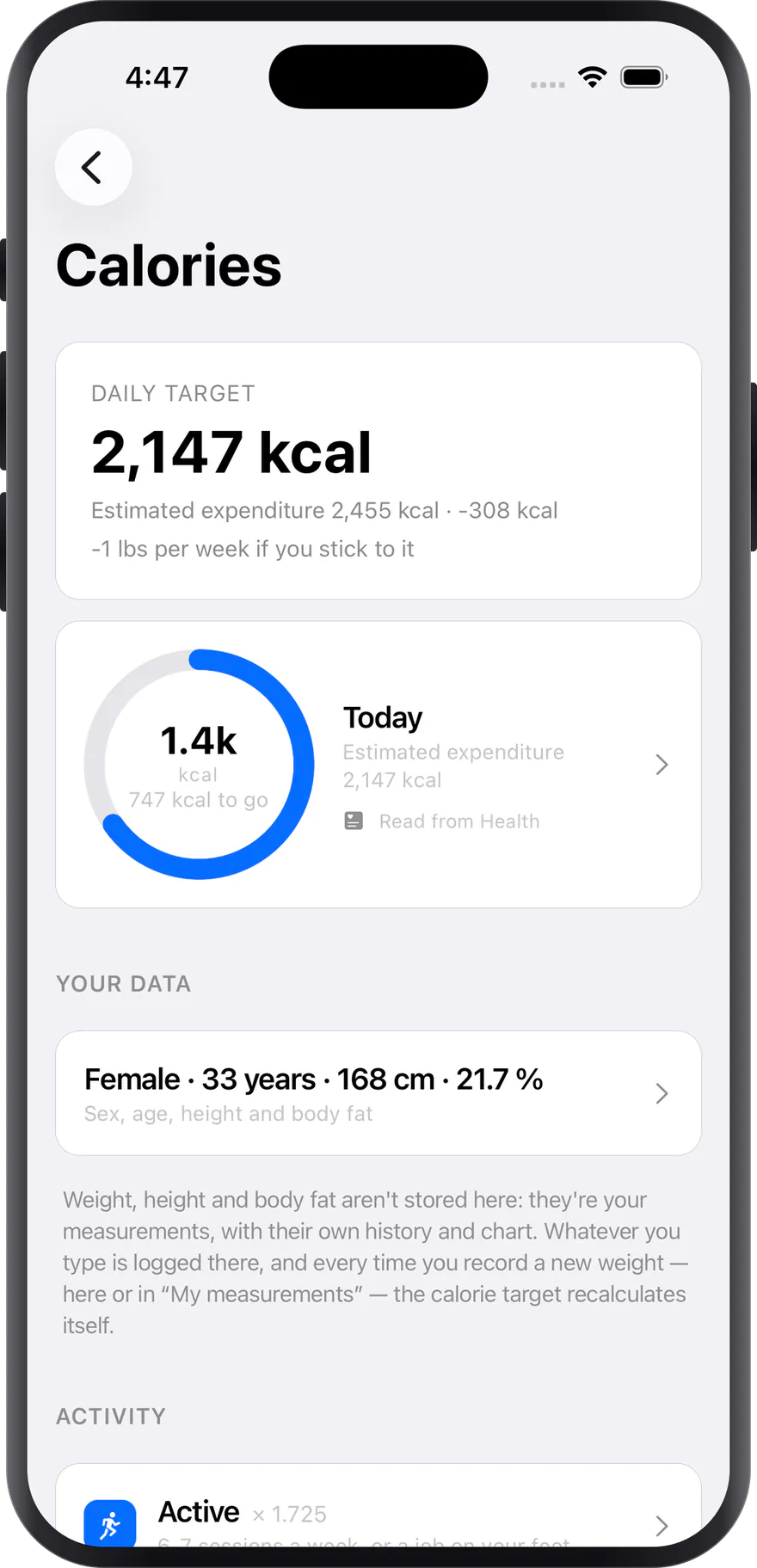
The daily target is worked out from your weight, height, age and activity, and it updates every time you log a new measurement. No going back through the form.