
Your first kilometers, without burning out in week two
Run easy when it’s time to, add weeks without getting injured and watch your distance grow. The app keeps every run and shows your progress; the guide explains how to start from zero.
- «I want to start running and don’t know how much or how fast»
- «I’ve tried before and gave up because of fatigue or niggles»
- «I’d like to run my first 5 km without stopping»
What happens today
Going out too fast
The most common beginner mistake: every run is a test, you’re out of breath after ten minutes and end up thinking running isn’t for you.
Building up too soon
Heart and lungs adapt faster than tendons and joints. Raise your volume as fast as your enthusiasm and the niggles arrive.
Not seeing progress
Without a log you don’t notice you can go twice as long as a month ago, and motivation drops just as you were improving.
What the app does
Every run, saved
Distance and time for every run, including the ones it reads from Health if you allow it.
Zones to run easy
Your zones with their pace: almost all of the time in the easy ones. Running slowly is training too.
Your progress, week by week
Distance and time compared with the previous period automatically: you see how far you’ve come even when you don’t feel it.
Weekly streak
The home screen counts the weeks in a row you’ve trained. The hard part is not breaking it.
A guide to get started
How to start running, how much to add each week and how to prevent injuries, with the source of every recommendation.
Which shoes to choose
A chapter to pick your first pair with judgement, not on what the shop shows you.
This is what you'll use every day
No mock-ups and no promises: the real screens of the app, exactly as they look on your phone.
- 01
Run
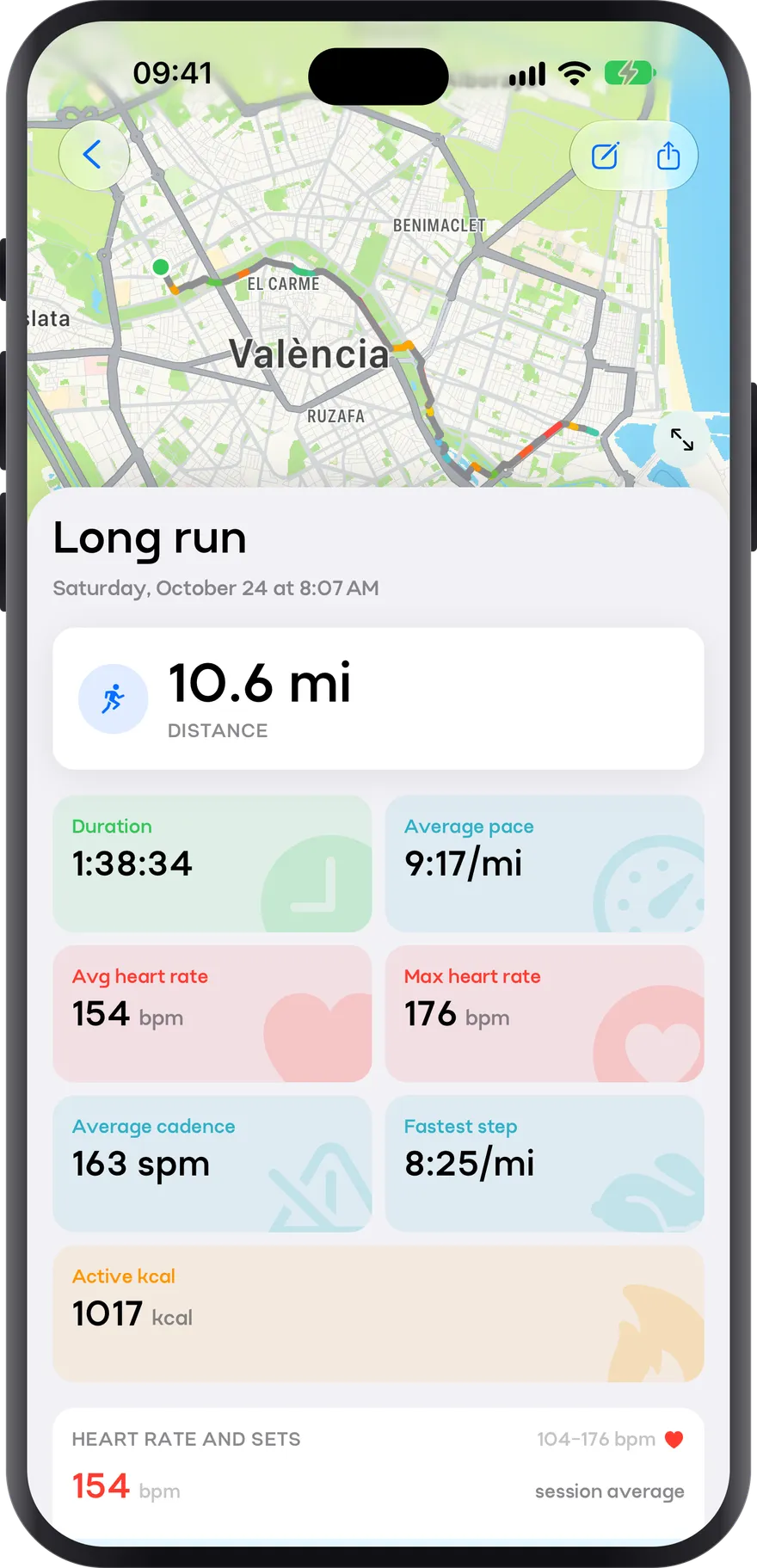
Every mile, measured
When you finish, the whole run at a glance: pace, heart rate and splits, with your route on the map coloured by how fast you were going. From your watch or from Apple Health.
- Route on the map, coloured by pace
- Average pace, average and max heart rate, and cadence
- Fastest split and active calories
- 02
Plan
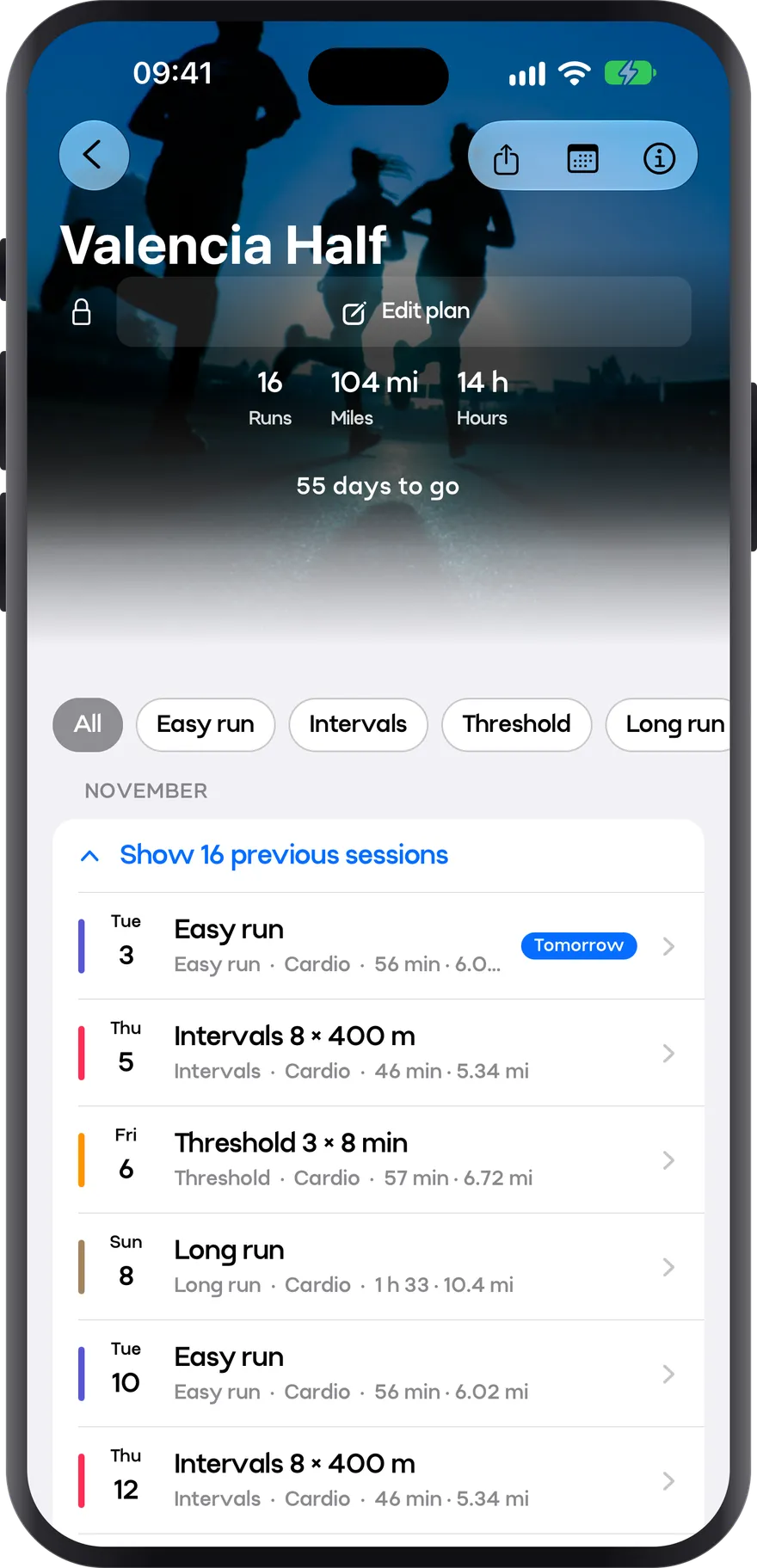
Your plan to the finish line
Pick the race and the date, and the plan takes you to the start line. Week by week, with paces built for you and the countdown always in view.
- Easy runs, intervals, threshold and long runs, each with its pace
- Countdown to race day
- Runs, miles and hours for the whole plan
- 03
Intervals
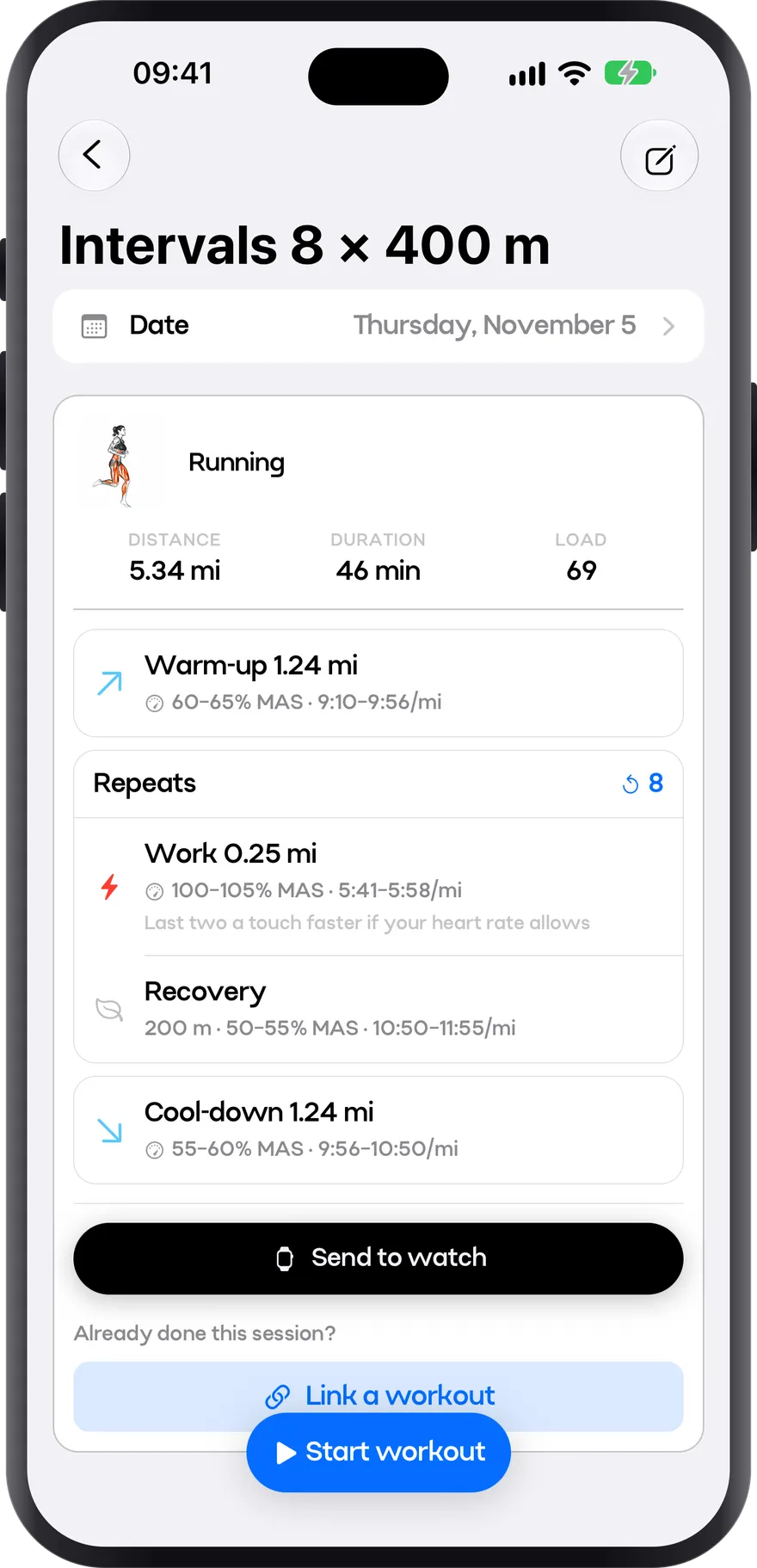
Intervals at the right pace
Warm-up, reps and cool-down, each with its pace. It all comes from your MAS, so there’s no guessing how fast to go. Straight to your watch.
- Target pace for every segment, per mile and as % of MAS
- Recoveries and cool-down already worked out
- Sent to your Apple Watch in one tap
How you use it
- 1
Start with run-walk
Easy running stretches alternated with walking. The guide tells you how to cut the walking week by week.
- 2
Save every run
The app logs distance and time and adds up your week.
- 3
Run in the easy zone
Check your zones and stay in the easy ones almost always.
- 4
Build up gradually
Watch your weekly distance and increase it little by little.
Starting to run: your first eight weeks
The walk-run method, how many days, how long, and why the classic beginner mistake is not running slowly but running too soon.
Training zones: measuring effort without kidding yourself
The three-zone model, where 80/20 comes from, how to estimate your threshold with a field test, and why most recreational runners train in a grey zone that achieves nothing.
Running injuries: what causes them and what can be done
How many injuries there really are, why load explains more than technique, what the studies say about prevention programs, and how to manage a niggle without stopping running.
How to choose running shoes: by use, by terrain and by the evidence
Why foot type should not drive your purchase, what cushioning, drop and weight mean according to the trials, which shoe suits each use and terrain, and how much carbon plates really give you.
Frequently asked questions
How many days a week should I run when starting?
Three non-consecutive days are a good starting point: they give your body time to recover between runs. The guide explains how to build up.
How fast should I run?
At a pace that lets you talk without gasping. At first almost everything should be easy; your zones tell you what that pace is.
Do I need a watch?
It isn’t essential. The app works on your phone, and if you use Apple Watch you can carry your intervals on your wrist.
Should I go to the gym too?
Yes: strength work helps tendons and muscles handle the impact. Lifting and running live in the same app.
Your first run starts today
Download My PR, go easy and let the app count the weeks for you.